Planning & Advice
Photographer and Videographer Handoff: A Toronto Wedding Plan
Plan a smooth Toronto wedding photo and video handoff: one shared timeline, a lead for each moment, agreed audio and light, permits, and clear rights.
 Weddings.io
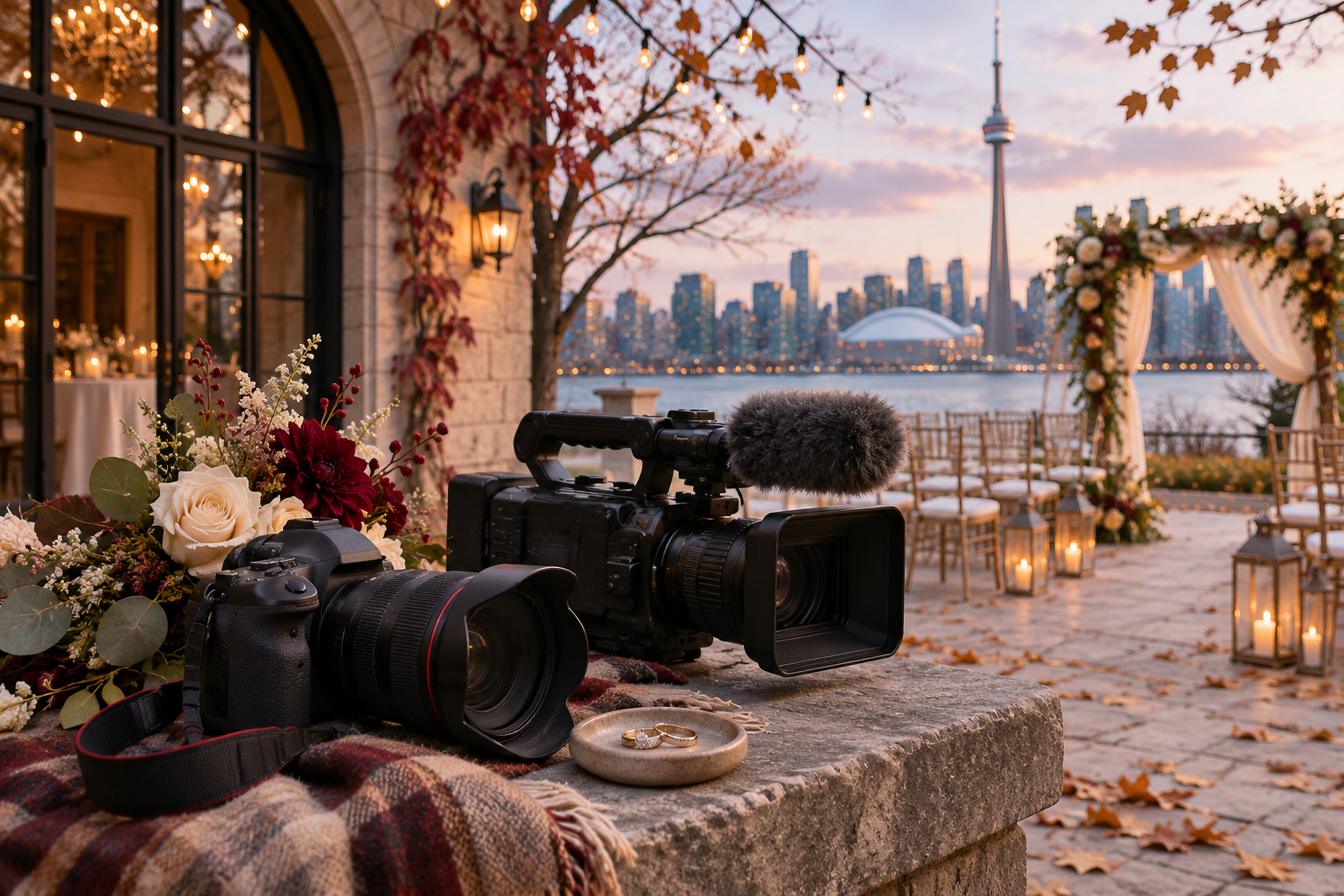
A smooth photographer and videographer handoff at a Toronto wedding comes from planning, not luck: build one shared timeline, decide who leads each moment, agree on audio and lighting, book any park permits early, and settle who can share which images. Introduce your two teams weeks before the day, not at the first look.
Couples often book their photographer and videographer separately, months apart, from different companies. Both teams are good at their jobs. Neither has worked with the other. On the day, they're both trying to capture the same few unrepeatable moments from the same few square metres. This guide covers how couples, planners and the vendors themselves can make that work, with the Toronto details that affect it.
Why the handoff matters
Photographers and videographers need different things from the same moment. A photographer wants to move, find angles and sometimes ask people to pause or repeat something. A videographer needs continuous footage, steady framing and clean audio, which means not having someone walk through the shot.
When nobody plans the handoff, you get the familiar problems: a photographer in the back of the video's first kiss, a videographer's light stand in the background of family portraits, two teams each asking the couple for "just five more minutes" during portraits until the cocktail hour is half gone.
None of this is anyone's fault. It's a coordination problem, and it's solved before the wedding.
Step 1: One timeline, shared by everyone
Every vendor should work from the same timeline, ideally one document the planner or the couple owns. It should list each event, its start time and location, and who has priority.
| Moment | Who usually leads | What the other team does | Notes to agree |
|---|---|---|---|
| Getting ready | Shared; often separate rooms | Each team takes a room, then swaps | Who covers which partner first |
| First look | Photographer for stills; video for reaction | Videographer shoots wide or from behind | Positions agreed in advance |
| Ceremony | Videographer for audio; photographer moves quietly | Photographer avoids the centre aisle during vows | Officiant's rules on movement |
| Family photos | Photographer | Videographer captures a few candid clips, then steps away | A written list of groupings |
| Couple portraits | Split time, e.g. photo first, then video | Each team waits off to the side | Time per team agreed |
| Speeches | Videographer for audio | Photographer shoots reactions from the side | Microphone plan with the DJ or venue |
| First dance | Shared | Opposite sides of the floor | Lighting agreed with DJ |
| Exit or sparklers | Shared | Opposite ends of the line | Venue rules on sparklers |
The "who leads" column is a starting point. Some teams prefer different splits. What matters is that they agree before the day.
Step 2: Introduce the teams early
Ask both vendors for their contact details and connect them by email or a short call two to four weeks before the wedding. Useful topics for that conversation:
- How many shooters each team is bringing
- Whether either team uses lighting that will appear in the other's frames
- Where each will stand during the ceremony and speeches
- Whether the videographer needs microphones on the officiant, the couple or the speakers
- How portrait time will be split
- Whether either team plans drone footage
Our sister site videographers.io has an industry focus on event coverage; use the shared timeline below as the starting point for your vendor conversation.
Step 3: Plan for Toronto light in late fall and winter
Light shapes everything about a wedding day's timeline, and Toronto's winter days are short. Check sunset and available light for the actual date and location with both teams. Sunset time alone does not tell you when a shaded portrait location will lose usable light, or whether weather will require an indoor plan.
For a late-fall or winter wedding, that usually means:
- Outdoor couple portraits in the early afternoon, or a first look before the ceremony
- Planning indoor portrait locations at the venue in case of cold, wind or freezing rain
- Asking both teams how they handle low light; the photographer may use flash, and the videographer may use continuous lights, which affect each other
Flash going off during video can create brief bright frames in footage. Some teams are used to working around this; others will want to agree on when flash is used. Ask.
Step 4: Toronto park permits
Many Toronto couples want portraits in a city park. The City of Toronto books wedding photography at listed park locations in two-hour slots, on the hour, and publishes a fee for each location. Edwards Gardens, Guild Park and Gardens, James Gardens and Rosetta McClain Gardens are listed at $509.70 per two hours, while locations such as the Music Garden, Kew Gardens and Toronto Island Park are listed at $182.08, taxes included. The City notes that outdoor sites are typically available from May 15 to September 30, depending on weather and availability.
The timing matters right now: the City says 2027 bookings open on Friday, November 27 at 8 a.m. If you're planning a 2027 summer wedding with park portraits, that's the day to book.
Make sure both teams know the permit window. A two-hour slot has to cover both photo and video portraits, and travel to and from the park eats into the day.
Step 5: Audio, the videographer's priority
Clean audio is often the difference between a good wedding film and a great one, and it's the part photographers are least likely to think about. Before the day:
- Confirm whether the officiant allows a lapel microphone
- Ask the DJ or venue whether the videographer can take a feed from the sound board for speeches
- Ask the photographer to avoid standing between speakers and the videographer's microphones
During the ceremony, the photographer's shutter sound can be picked up by nearby microphones. Many photographers switch to a silent shutter during vows. It's worth asking.
Step 6: Drones, carefully
Drone footage is optional coverage, not a reason to compromise the ceremony or crowd safety. Ask the operator to assess the precise location, airspace, aircraft and proposed operation under Transport Canada's current categories. Do not reduce the decision to whether the venue says yes.
Basic operations have specific conditions, including uncontrolled airspace, visual line of sight and separation from people and airports. The pilot must hold the appropriate certificate and carry registration evidence for that category. Advanced operations have additional requirements; a certificate alone is not blanket permission to fly at every wedding location. Different rules apply to microdrones, and they are not permission to fly recklessly.
Have the operator confirm any airspace authorization, site restrictions and venue permission before including a flight in the timeline. A park photography booking does not establish drone authorization. Avoid a plan that depends on flying over assembled guests. If weather, people or permissions prevent the shot, the agreed ground-based alternative should allow the wedding to continue normally.
Step 7: Settle image and footage sharing
The current Copyright Act generally makes the author the first copyright owner, subject to the Act, including employment rules and valid agreements. Paying for coverage does not by itself give a couple unlimited rights to transfer work between vendors.
Section 32.2(1)(f) permits specified private or non-commercial use of a photograph or portrait commissioned by an individual for personal purposes and made for valuable consideration, unless the individual and copyright owner agreed otherwise. That provision is not a general licence for a vendor's commercial portfolio, and it should not be assumed to cover every use of a wedding film.
For a two-vendor wedding, the questions to settle in writing are:
- Can the videographer use some of the photographer's images in the film, or vice versa?
- Can each vendor share the other's work on social media or in portfolios, and with what credit?
- What can the couple do with the images and film commercially, if anything?
Your contracts are the place to answer these. We're not lawyers, so read your contracts carefully and ask the vendors to clarify anything unclear.
A sample late-fall Toronto timeline
Every wedding is different, but here's how a late-November or December day with a 2 p.m. ceremony might share time between two teams. Adjust it with your own vendors.
| Time | Event | Photo team | Video team |
|---|---|---|---|
| 10:00 a.m. | Getting ready begins | Partner A's room | Partner B's room |
| 11:00 a.m. | Teams swap rooms | Partner B's room | Partner A's room |
| 12:00 p.m. | First look, indoors or sheltered | Leads; close angles | Wide shots and reactions |
| 12:20 p.m. | Couple portraits, part 1 | 25 minutes | Waits nearby, captures arrivals |
| 12:45 p.m. | Couple portraits, part 2 | Steps back | 20 minutes for film portraits |
| 1:15 p.m. | Wedding party photos | Leads | A few candid clips |
| 2:00 p.m. | Ceremony | Moves quietly, silent shutter for vows | Leads on audio, fixed positions |
| 2:45 p.m. | Family photos | Leads with a written list | Steps away to film cocktail hour |
| 3:45 p.m. | Last outdoor light | Optional short portraits | Optional golden-hour clips |
| 5:30 p.m. onward | Dinner, speeches, dancing | Reactions and candids | Leads on speeches with board audio |
Notice that both teams get dedicated portrait time before the ceremony. In winter, that's often the only daylight portrait window you'll have.
Questions to ask each vendor before you book
If you haven't booked both vendors yet, these questions help you choose a pair that will work well together:
- Have you worked alongside a separate photo or video team before? Most experienced vendors have. Ask what they do to stay out of each other's shots.
- How much portrait time do you need? If each team asks for 45 minutes, you need an hour and a half, which is hard in December.
- Do you use flash or continuous lights at receptions? Ask both, then make sure the answers are compatible.
- How do you handle ceremony audio? Videographers should have a clear plan; photographers should know about it.
- What do your contracts say about sharing images and footage? Compare the two contracts before signing either.
- Will you join a short planning call with the other vendor? A yes is a good sign.
Checklist: photographer and videographer handoff
- [ ] Both vendors have the same written timeline
- [ ] Teams introduced two to four weeks before the wedding
- [ ] "Who leads" agreed for each key moment
- [ ] Portrait time split between teams, with minutes for each
- [ ] Sunset time checked and outdoor portraits scheduled before it
- [ ] Indoor backup locations for cold or wet weather
- [ ] Park permit booked, with both teams fitting inside the slot
- [ ] Microphone plan agreed with officiant, DJ and venue
- [ ] Silent shutter during vows discussed
- [ ] Drone plan confirmed with certificate and venue permission
- [ ] Image and footage sharing settled in writing
Mistakes couples tell vendors about afterward
Booking vendors who have never spoken. A short call prevents most problems.
Underestimating portrait time. Two teams need more time than one. Build it into the day.
Forgetting the light. A 4 p.m. outdoor portrait in December can be almost dark.
Assuming everyone can share everything. Rights depend on contracts, not on who paid.
Confirm these dated details when booking
Toronto's park page was checked on November 26, 2026. Its stated 2027 booking opening is November 27 at 8 a.m.; location availability and published fees should be rechecked when reserving. Keep the booking confirmation, applicable conditions and agreed photo/video scope with the shared timeline. They are more useful on the day than a screenshot of an old price list.
Give both teams a plan they can use
Your photographer and videographer are both trying to give you the best record of your day. Give them one timeline, a clear lead for each moment, enough time and light, and the permits and rights sorted in advance. A short introduction call gives both teams a chance to identify conflicts while there is still time to resolve them.
Worked example: a late-running portrait session
Suppose the illustrative timeline above runs fifteen minutes late because preparations took longer than expected. This is a planning example, not a reported Toronto wedding. The photographer still needs the agreed family groupings, while the videographer wants a short movement sequence. Letting each team independently reclaim its lost time can push the ceremony preparation later again.
Instead, the planner calls the pre-agreed priority order. The teams retain the essential first-look coverage and shorten optional portraits, with one clear transition to the video segment. The videographer selects one suitable setup rather than moving to several backgrounds. The photographer knows when the transition happens and can use that period to prepare the family list rather than competing for the couple's attention.
The couple should decide these priorities in advance. Some will prefer family photographs over extra couple portraits; others will prioritize a particular cultural or religious moment. Record those preferences without promising that every request will fit every delay. A shared fallback order makes the tradeoff explicit and keeps the couple from mediating two competing instructions while guests wait.
Separate essential coverage from optional creative shots
Give both vendors the same list of moments that cannot be repeated, together with names and pronunciation notes where helpful. Identify the people who must appear in formal photographs and any sensitive family arrangements. A trusted helper can gather groups without asking the camera teams to search the venue for relatives they have never met.
Then keep a separate short list of optional creative ideas. A social-media reference is a discussion aid, not a guarantee of the same weather, architecture or available light. Ask each team which ideas fit its style and equipment. Agree on what can be dropped if travel or ceremony timing changes.
During the ceremony, the officiant's rules and the couple's experience come before a vendor's preferred angle. Confirm where cameras and stands may be placed and whether movement is restricted. Teams can choose compatible positions beforehand rather than making silent assumptions about opposite sides of the aisle. The best position for one room may obstruct another camera in a different room.
Agree on audio access without treating the DJ feed as a guarantee
Ask the videographer how the sound-board connection will be tested and what backup recording method is planned. The DJ's amplified sound and the film's recorded sound are related but separate systems. A cable connection alone does not establish that a clean recording is being captured.
Identify who helps attach and remove any personal microphone, when that happens and how privacy is handled between recorded moments. Do not have a photographer move a microphone or disconnect equipment to improve a composition without coordinating with its operator. Similarly, lighting changes for video should be discussed before formal still portraits begin.
Record the responsibility for speeches that happen unexpectedly. The planner or master of ceremonies can give both teams notice before a microphone is handed to a speaker. This is more useful than assuming the videographer can capture every spontaneous remark while moving equipment to another room.
Make the post-wedding handoff just as clear
Before the wedding, ask what each vendor delivers, in which formats and on what contractual schedule. Edited photographs, a highlight film, full ceremony footage and raw files are different deliverables. Do not assume that booking both teams creates an obligation for either to provide unedited material or transfer entire archives to the other.
If one vendor wants to use another's work, request permission for the actual use: which files, what edit, where it will appear, required credit and whether the couple has approved publication. Credit alone does not establish permission. Also tell the teams about guests or moments that should remain private and confirm how those requests fit the agreements.
Keep delivery and revision contacts in the same planning folder as the contracts. If a promised item is missing, refer to the defined deliverable rather than an informal expectation. A good handoff continues after the final dance: both vendors know what they owe the couple and what they may share with each other.
Frequently asked questions
- How do photographers and videographers share wedding coverage?
- Use one shared timeline, agreed camera positions, a lead for each moment and dedicated portrait time for each team. Decide beforehand which optional shots can be shortened if the day runs late.
- When do Toronto’s 2027 park photography bookings open?
- The City page checked November 26, 2026 states Friday, November 27 at 8 a.m. Confirm availability and the applicable booking conditions directly with Park Bookings.
- Does a Toronto park photography booking cover drone filming?
- Do not assume so. The operator must confirm the actual aviation requirements, airspace permissions, site restrictions and venue permission for the proposed flight.
- Does paying a wedding photographer transfer copyright?
- Not automatically. The Copyright Act generally identifies the author as first owner, subject to its exceptions and valid agreements. Confirm the specific delivery, sharing and publication permissions in the contract.
- Should the photographer and videographer both get portrait time?
- Agree on a realistic allocation with both teams before the wedding, including transition time. Preserve essential coverage and identify optional shots that can be dropped if needed.