The Business of Weddings
The Next Great Wedding Idea Might Come From Behind the Scenes
The people making wedding days happen may be the people who spot the next useful innovation.
Planners, photographers and venue teams see the everyday problems first. Their experience could shape wedding tools that leave more room to enjoy the celebration.
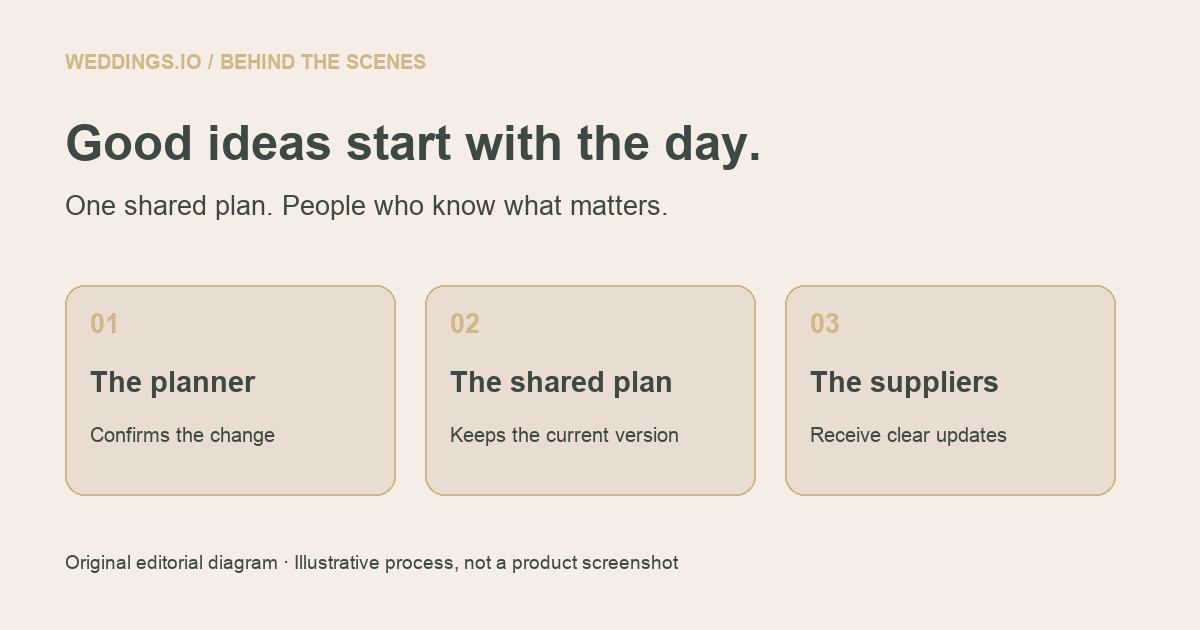
Original explanatory graphic: Weddings.io Editorial. Illustrative coordination process, not a product screenshot.
A wedding planner notices that every supplier has a slightly different timeline.
A photographer spends another evening untangling a family photograph list. A venue coordinator answers the same arrival questions for the fifth time.
Somewhere inside those everyday frustrations is the beginning of a useful idea.
The next wedding innovation could come from someone who spends Saturdays making celebrations happen—and has finally found a way to fix the thing that keeps getting in the way.
Good ideas often begin with an ordinary problem
Imagine a planner who could turn approved schedule changes into a clear update for each supplier.
The caterer receives the revised service time. The photographer sees the effect on portraits. The transport team gets the new departure arrangements.
Everyone works from the same agreed plan, without searching through a long conversation to discover which message superseded the others.
That is a useful ambition. It starts with understanding how wedding days actually work.
AI tools can help a practitioner sketch and test ideas like this. A working example can make a conversation with a developer more concrete: here is the problem, here is what should happen, and here is where the first attempt went wrong.
Couples should feel the benefit
For couples, the technology itself is rarely the point.
The benefit might be fewer repeated questions, a clearer comparison between supplier quotes or confidence that an important family request reached the right person.
A useful tool should leave more room for the celebration. It should make the practical work easier to understand, particularly when several people are making decisions together.
The best feature might be the one you barely notice because the handoff simply works.
Wedding experience brings valuable judgment
Someone who works weddings knows that a schedule is more than a sequence of times.
It includes travel, setup, ceremony requirements, access, meals, changing outfits and people who need a little extra help moving between places.
They also know when a detail needs a conversation. A family tradition cannot always be reduced to a checkbox. A seating suggestion may miss a relationship that nobody wants recorded in a shared document.
That experience helps identify where automation is useful and where a person should remain involved.
A clever tool still needs care
A promising prototype should be tested before couples and suppliers rely on it.
Does it show which version is current? Can the couple correct information? Does everyone understand who can see what? What happens if the connection fails on the morning of the wedding?
A tool should also distinguish a suggestion from a confirmed arrangement. Drafting a message is different from sending it. Recommending a supplier is different from confirming availability.
Clear boundaries make the experience easier to trust.
Look for people who understand the day
This is an opportunity for planners, venue teams, photographers, caterers and other wedding professionals to help shape the tools they use.
They do not all need to become software companies. Sometimes the useful outcome is a better process within one business. Sometimes an idea deserves a technical partner and a wider audience.
For couples, the question remains simple: does this help us make decisions, communicate clearly and enjoy our wedding?
The next great wedding idea may begin with someone packing away after a long reception, thinking about one small thing that could have made the day easier.
That is a good place to start.
Editorial perspective. The examples are possibilities, rather than features being announced by Weddings.io.