Traditional & Religious Weddings
Traditional & Religious Wedding Planning Guide 2026: Catholic, Anglican, Orthodox & Christian Ceremonies
Catholic Nuptial Mass, Anglican BCP service, Orthodox crowning, church music, unity ceremonies, and rehearsal dinner protocol.
Complete 2026 guide to traditional and religious weddings: Catholic Nuptial Mass timing, Anglican Book of Common Prayer service, Orthodox crowning rite, church music, unity candle and sand ceremonies, vow customisation, and rehearsal dinner protocol.
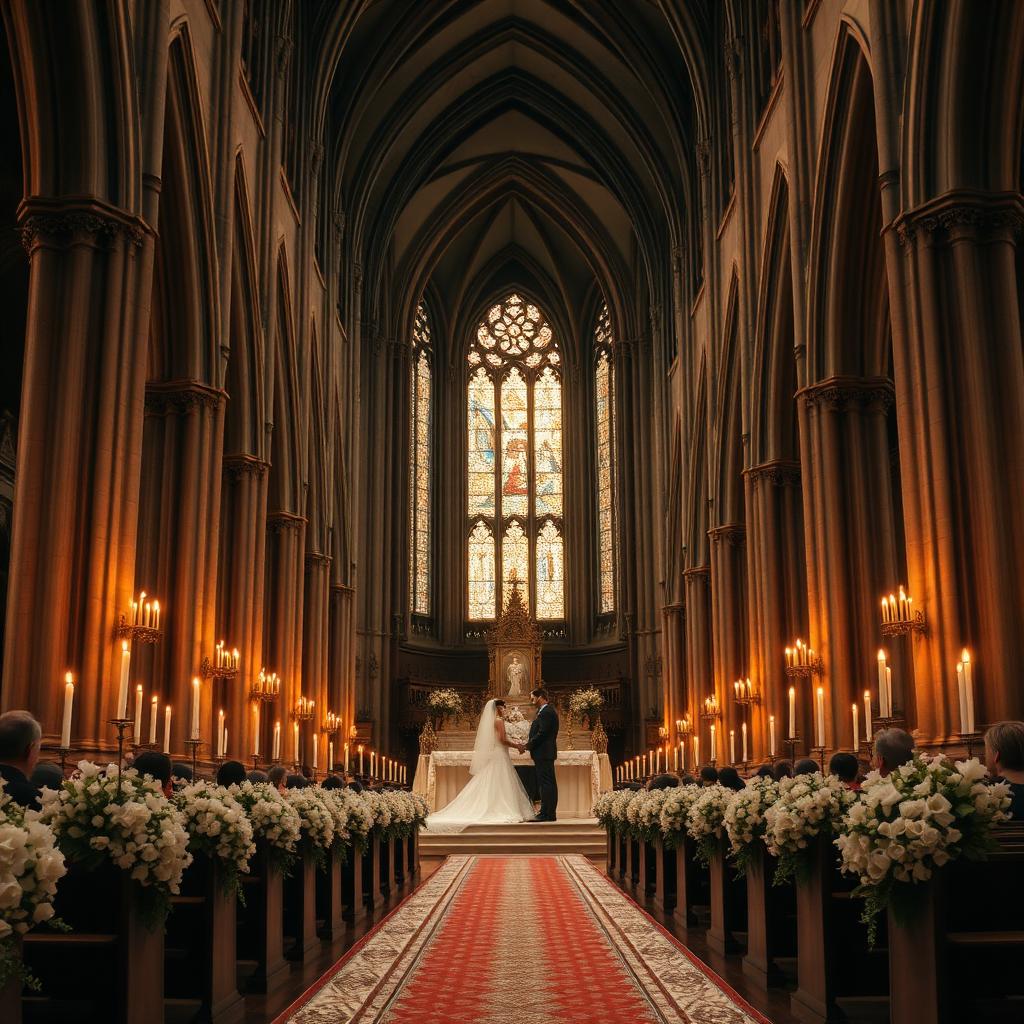
A traditional religious wedding is one of the most structured ceremonies a couple will ever plan. Unlike civil or contemporary weddings, the order of service, music, vows, and even the position of the wedding party are governed by centuries of liturgical practice — and the celebrant, not the couple, has the final word on what is permitted. The job of the planning team is to honour the liturgy while still creating a personal, well-paced experience for the guests, the families, and the couple themselves. This guide covers Catholic, Anglican, Orthodox, and broader Christian church weddings in 2026.
A Catholic Nuptial Mass — the full sacramental ceremony with Eucharist — runs 60 to 75 minutes. The structure is fixed: processional and entrance hymn (6–8 minutes), greeting and opening prayer (3 minutes), Liturgy of the Word with two readings, responsorial psalm, gospel acclamation, gospel reading, and homily (20–25 minutes), the Rite of Marriage with address, consent, vows, ring blessing, and exchange (12 minutes), the Liturgy of the Eucharist including preparation of gifts, Eucharistic prayer, Lord's Prayer, sign of peace, and Communion (20–25 minutes), and finally the Nuptial Blessing, signing of the register, and recessional hymn (7 minutes). When one partner is non-Catholic, the ceremony is usually celebrated as a Rite of Marriage outside Mass, which compresses to 30–40 minutes and skips the Liturgy of the Eucharist.
Anglican weddings follow the Book of Common Prayer (1662, 1928, or contemporary Common Worship 2000) and run 45–60 minutes for a full Eucharist or 30 minutes for a marriage service without communion. The structure mirrors the Catholic rite — gathering, ministry of the word, marriage, prayers, and dismissal — but the vows are the classic 'to have and to hold from this day forward, for better for worse, for richer for poorer, in sickness and in health, to love and to cherish, till death us do part.' Anglican weddings are typically more flexible on music and personalisation than Roman Catholic ceremonies. Confirm scripture readings, hymn choices, and any personal additions with the parish vicar 6–8 weeks before the wedding.
Orthodox weddings — Greek, Russian, Serbian, Romanian, Bulgarian, Antiochian — are organised around the Service of Crowning (Stefanoma), the rite that constitutes the marriage in Orthodox theology. The full service runs 45–60 minutes and has two clear parts: the Betrothal Service, in which rings are exchanged by the priest three times, and the Service of Crowning, in which matching crowns (stefana) are placed on the bride and groom, joined by a ribbon. The koumbaro (Greek) or kum (Slavic) — a sponsor figure analogous to the best man but with sacramental weight — holds and adjusts the crowns. The couple then walks three times around the ceremony table in the Dance of Isaiah, sharing a common cup of wine. There are no spoken vows in the Western sense; the act of crowning is the consent.
Church music for a traditional wedding is a four-moment programme: processional, offertory (or signing of the register in non-Mass services), communion, and recessional. Catholic and Anglican parishes generally require sacred or liturgical music for the processional and Eucharistic moments. Standard repertoire includes Canon in D by Pachelbel, Trumpet Voluntary by Clarke, Jesu Joy of Man's Desiring by Bach, and Ode to Joy by Beethoven for processionals; Ave Maria (Schubert or Bach/Gounod), Panis Angelicus by Franck, and How Great Thou Art for offertory and communion; and the Wedding March by Mendelssohn, the Hornpipe from Handel's Water Music, or contemporary triumphant pieces for the recessional. Most dioceses restrict secular pop music to the reception. Always submit a music list to the parish organist or music director at least 6–8 weeks before the wedding for approval.
Flower girls and ring bearers occupy a small but production-critical slot in the processional. The optimal age range is 4 to 8 — younger children are unpredictable, older children should be addressed as junior bridesmaids or groomsmen. They walk immediately before the maid of honour, or in some traditions immediately before the bride. Schedule three full rehearsal runs at the church the night before. Pre-position a parent in the front pew so the child can sit down immediately after the entrance, and brief an aunt, grandparent, or sibling as a shadow backup in case of stage fright or tears. Their props (basket of petals, ring pillow with mock rings — never the real rings) should be ready 30 minutes before the ceremony.
A unity rite — unity candle, sand ceremony, or wine ceremony — is an optional symbolic act inserted after the vows. In a Catholic Mass it is placed before the Liturgy of the Eucharist; in a non-Mass ceremony it sits before the final blessing. The unity candle uses two taper candles (lit by the mothers during the processional) that the couple uses to light a single pillar candle. Sand ceremonies, popular in outdoor and non-Catholic weddings, layer two coloured vials of sand into a single vessel. Wine ceremonies, sometimes used in Anglican services, involve sharing a common cup. The whole rite takes about 3 minutes. Confirm whether your celebrant permits a unity ceremony — many traditional Catholic parishes do not.
Vow customisation in a religious ceremony is more constrained than couples often expect. The Catholic Church requires the canonical form of consent: 'I, _, take you, _, to be my wife/husband. I promise to be faithful to you, in good times and in bad, in sickness and in health, to love you and to honor you all the days of my life.' Personal additions are not permitted within the consent itself, but couples may add a short personal blessing during the ring exchange or include personalised intentions in the Prayers of the Faithful. Anglican BCP vows are equally canonical. Where personalisation is most welcome is the wedding programme, the readings (couples can choose from approved scriptures), the homily content (worked out with the celebrant), and the music programme. If fully personalised vows are essential, consider a civil ceremony followed by a separate religious blessing.
The rehearsal dinner is a standard component of a traditional Western wedding and a non-negotiable for weddings with 4+ attendants per side or significant out-of-town family. It is held the evening before the wedding, traditionally hosted by the groom's parents, and follows a 45–60 minute walk-through rehearsal at the church or venue. Guest list usually includes the wedding party, immediate family, the officiant, and out-of-town relatives — typically 20–50 people. Budget $50–$150 per head for a sit-down dinner. The standard run-sheet: arrival and cocktails at 6:00, dinner at 6:30, toasts at 7:30 (parents first, then maid of honour, then best man), couple's thank-you and gift presentation to wedding party at 8:15, coffee and mingle to 9:30, with the wedding party home by 10:30 so no one is hung-over for portraits.
Reception planning for a religious wedding differs from the church service in tone but should be sequenced with the same precision. Cocktail hour begins immediately after the recessional and signing of the register — typically 5:30 to 6:30 if the ceremony started at 4:00. The wedding party photo sequence (family formals at the altar, then bridal party at the steps, then couple portraits in 3–4 setups) needs 45–60 minutes and a written shot list signed off by the photographer 1 week before. The reception then follows a standard order: grand entrance, blessing or grace, first dance, dinner service with toasts between courses, parents' dances, open dancing, cake, bouquet and garter, and final send-off. Most traditional Western receptions run 5 to 5.5 hours of formal programming.
Weddings.io treats traditional and religious wedding planning as a sacred-and-secular system. The ceremony is governed by the parish; the operational layer — vendor coordination, music cueing, processional choreography, photography access at the altar, rehearsal dinner logistics, and reception flow — is governed by the couple's planner. Both must work together with the celebrant, the church music director, and the venue coordinator. When that coordination breaks down, ceremonies run long, photos get missed at the altar, the recessional hymn ends before the wedding party has cleared the aisle, and the reception starts 40 minutes late. When it works, the couple gets a sacred ceremony and a celebratory reception that feel like one continuous, intentional day.
Frequently asked questions
- How long is a Catholic Nuptial Mass?
- A full Catholic Nuptial Mass with Eucharist runs 60–75 minutes. A Rite of Marriage outside Mass (used for mixed-faith couples) runs 30–40 minutes.
- What music is allowed in a Catholic or Anglican wedding?
- Most parishes require liturgical or sacred music for the processional, offertory, communion, and recessional. Secular pop music is restricted to the reception. Standard repertoire includes Canon in D, Trumpet Voluntary, Jesu Joy of Man's Desiring, Ave Maria, and the Mendelssohn Wedding March. Confirm the full music list with the church organist 6–8 weeks before the wedding.
- What is the Orthodox crowning ceremony?
- The Service of Crowning is the central rite of an Orthodox wedding. The priest places matching crowns (stefana) on the bride and groom, joined by a ribbon. The couple then walks three times around the ceremony table — the Dance of Isaiah — with the koumbaro following. The act of crowning constitutes the marriage in Orthodox theology; there are no spoken vows.
- Do we need a rehearsal dinner the night before?
- A rehearsal dinner is standard for traditional Western weddings with a wedding party of 4+ on each side or significant out-of-town family. It is held after the ceremony walk-through and traditionally hosted by the groom's parents. Guest count is usually 20–50 people; budget $50–$150 per head.